It’s one of those topics you don’t normally see on a blog. Of course, you can find resources, I did and I’ll share, but why not come here so you can hear it from me in a language you can understand.
At the beginning of the COVID-19 pandemic, it was all the rage to do a little more stewardship, make more phone calls, send more “personal” emails (personal as in from you, not sharing your personal Tinder info or things like that”. So that is what I did. They were personal in a way that reflected my interest in donor wellbeing, mental health, and saying that “we’re all in this together” and “be safe, wash your hands” and trying to be optimistic and cheerful. And that was all genuine. I wanted them to stay strong, stay healthy, and know I care (still do). But one of the things I also wanted to do to make it personal was to add photos that reflected my personality.
Enter exhibit one: Rocky Balboa. Philadelphia. At the top of the stairs. Victorious.
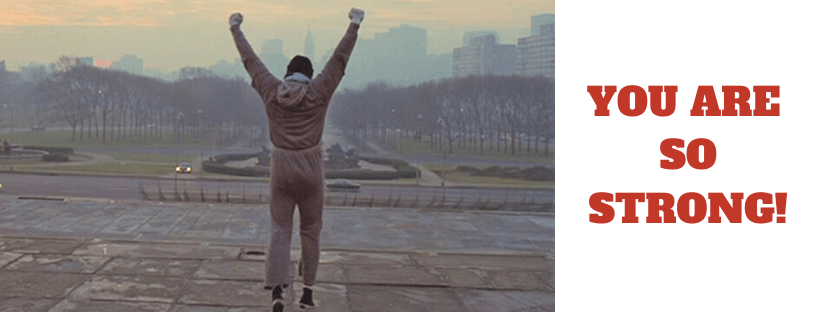
I totally used that photo and customized it for my email. Everyone that received that email was called Rocky Balboa’s of COVID-19.
So, is that copyright infringement? Did I put my organization at risk for litigation? Maybe? But most likely not.
Copyright law specifically gives the owner of the copyright the exclusive right to reproduce and authorize others to reproduce the work, prepare derivative works based on the copyrighted material, and perform and/or display the work publicly (The Practice of Public Relations, Pearson, 2020). But there is also such a thing as “fair use”. And “fair use” can be tricky.
Thankfully, The Public Counsel Law Center has given this wonderful document that is focused on copyright & fair use for non-profit organizations. They define fair use as “the right to use copyrighted material under certain circumstances without consent of the author or owner of the copyright.” What are the certain circumstances? Who decides what “certain circumstances” are? Are there some fairly common examples of fair use?
Let me answer these backwards.
Common examples of fair use would be journalism, parody, or research. Think Weird Al Yankovich. Saturday Night Live, book reviews, movie reviews, and pretty much every educational setting you’ve been in.
If someone were to call the Rocky copyright owners and say, Jennifer used a photo of Rocky in an email. The owner’s would file a suit in court. Then, the courts would decide. Then, they would consider a few things.
Why did I use it?
What kind of work was used?
How much of the material did I use?
Is it being used to generate income?
In this case, the photo was used to symbolize strength and perseverance. It was one photograph, not a full movie. And no, it wasn’t used to generate income. I wasn’t making something new with the photo or transform it in some way.
Honestly, “fair use” of copyrighted material is a pretty gray area. They’re aren’t any set rules or guidelines. Just be sure that, before you use anything with the © symbol or is noted as copyright in footnotes, watermarks, or other information indicating that it is copyrighted material, take a moment to ask yourself these three questions (from Public Counsel Law Center):
Has the material I took from the original work been transformed by adding new expression or meaning?
Was value added to the original by creating new information, new aesthetics, new insights, and understandings?
Did I use the work for my own personal commercial gain or to profit financially, or was there a broader benefit to the public?
It is also recommended that you use a “fair use worksheet”. I found an online worksheet here.
At the end of the day, be smart, be diligent, and ask for permission when you can. It’s tricky. And by all means, download this PDF for a very thorough look into copyright and your non-profit organization.
And yes, there is a trademark copyright reference in The Office. Enjoy! (Ignore the title of the video, I can’t control all of the internet.)
 Fundraising with Jenn